


“Add a zero.”
In my mind’s eye, that’s how the conversation ended between high-ranking Disney executives, when trying to decide if they have pushed the boundary far enough, if they have TRULY tested charging “what the market will bear.” In itself, there’s nothing evil in this thought experiment. If you’re a business, you really do want to find optimal pricing. Now, that might not always mean truly charging the upper limit of what the market will bear – you might develop resentment about elitism otherwise *cough* MODERN DISNEY *cough*. But it also doesn’t hurt to actually figure out just where that limit is. One wants to live in the world of facts and data, not conjecture.
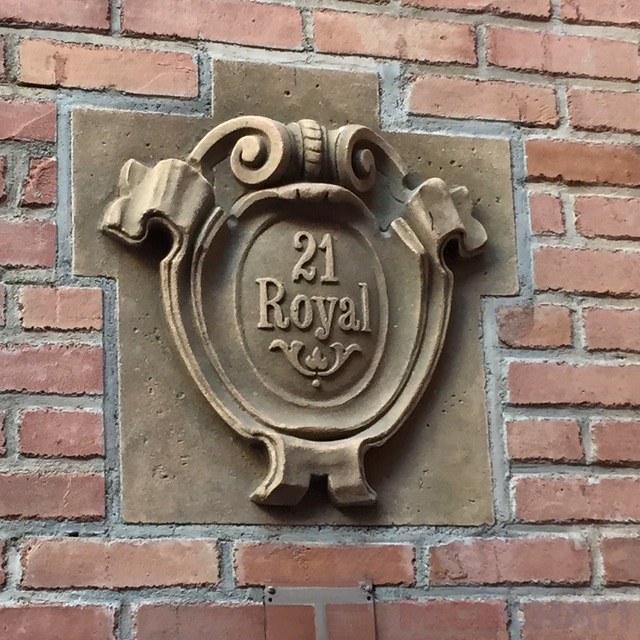
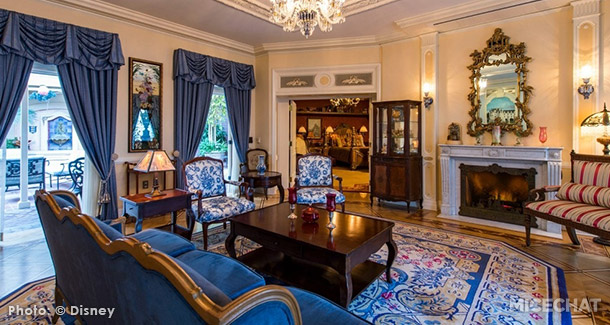
We’re talking today of 21 Royal Street, a private dining area in the former Dream Suite (and before that, Disney Gallery) space above Pirates of the Caribbean at Disneyland. This area was once earmarked for Walt and Lillian’s private apartment within Disneyland (meant to augment – or more likely replace – the one above the firehouse on Main Street). He died before plans were finalized, and the space was thus left empty for years before the Disney Gallery took up residence in the late 1980s. In the past couple of years, the space was refurbished to a version of the original plans for a New Orleans themed apartment, and made available as the “Dream Suite” to members of the exclusive (and largely secretive) Club 33 for private dinners. Last week, the announcement came that now the public can also rent this space, for $15,000 per evening, with an expansive dinner for up to 12 people. That’s $1,250 per person – ouch!

Disney has, in recent years especially, become known for creating experiences that cost extra. I’ve written recently about price segmentation and upselling at Disney, pointing out that the “one size fits all” model of treating every Guest to the same experience was a) never true even in the “populist Walt” eras, and b) primarily a superficial reputation cultivated by appearances rather than reality. But the appearances are definitely changing, and people are finally seeing the class divides, which I think is creating a marketing problem for Disney, albeit a slow-moving one. You see where incipient marketing problems got SeaWorld, though, so if I were them I’d think twice about perceptions.
Disney ALREADY has the “basic” options that you can start with, and choose to not upsell. Buy the theme park ticket, skip the backstage tour, skip the table service restaurant, skip the $650 private cabana next to Space Mountain, skip the $15/person parkhopper backstage bus, and skip the pricey souvenirs. So, yes, there is a “basic” option. It can absolutely be argued, of course, that even the “basic” options are not cheap and not really meant for every class of income in the United States. There’s plenty of research that lower-income families lack the disposable income to fly (or even drive) to a Disney park, pay for a (probably non-Disney) hotel, and pay $100 admission per person into the park. So let’s not pretend we’re dealing with a situation designed for every income strata. The parks are already geared for the middle class, and arguably the price increases in hotel rooms, food options (even fast food), and admission tickets might mean we’re starting to tick toward only upper-middle class.
Even before up-sell opportunities (such as Fantasmic dining packages, fireworks dessert parties, Wild Africa Trek at DAK, etc), Disney has long had price segmentation. If you make $40,000/year as a household, probably you are eating at Disney’s fast food. If you make $100,000/year as a household, you might be more likely to dine at table service. THIS is the moment where I imagine a Disney executive saying: “add a zero.”
The way the Long Tail works, it might make sense to withhold experiences/services/products from “the masses” if you can sell the same thing to the ultra-rich for much more. Even if you fail to sell the thing on some days, but do sell it on other days, you will come out ahead. That means it might make sense to explore whether the Long Tail actually extends to the truly rich. If you’ve got people willing to pay $80/person for a meal at Blue Bayou (factoring in appetizer, dessert, and gratuity), why not find out if there are people willing to pay if you “add a zero” to the total? $800 might seem like an awful lot to pay for a single evening’s meal for most people (certainly including me), but let’s also remember some context when you move up to the truly expensive dining.
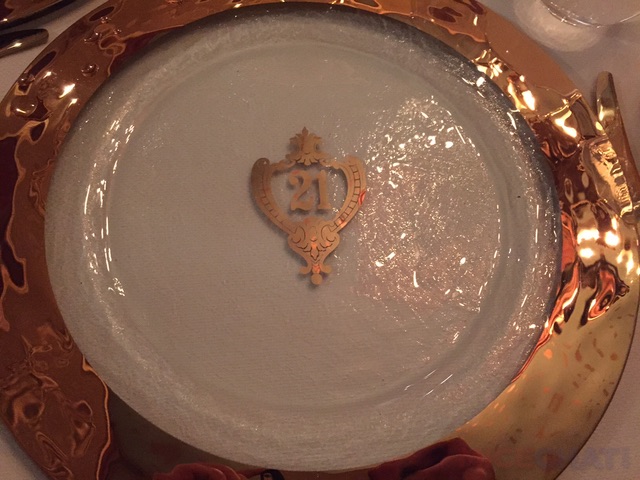
First, Disney is promising a 7-course meal at 21 Royal Street. If you’ve never done truly expensive dining, you are almost certainly underestimating the luxury that ensues when you’re treated to a multi-course meal of small bites on a seemingly never-ending succession of clean plates. I’ve done it at Victoria & Albert’s, WDW’s 5-star establishment that is worth every cent of its $200 (or so) price point. Marketers overuse the word “experience,” but that’s entirely what you get at V&A.
You are also underestimating the ingredients. If you’ve consumed a steady diet of Kraft Mac and Cheese, chain restaurant fast food, or even Disney fast food, we aren’t talking about the same planet and possibly not even in the same Newtonian universe. Even Disney table service (such as Blue Bayou) is not anywhere close to the type of service, attention, customization, and ingredients as Victoria and Albert’s. It’s hard to define unless you’ve eaten this type of food, prepared by a 5-star caliber chef. One hesitates to call it “food,” actually, since it’s so different from anything else. It’s more like placing morsels of happiness into your mouth one forkful at a time, exposing your senses to parameters previous unimagined. Despite the marketing overuse, such an extravagance really is an “experience.”
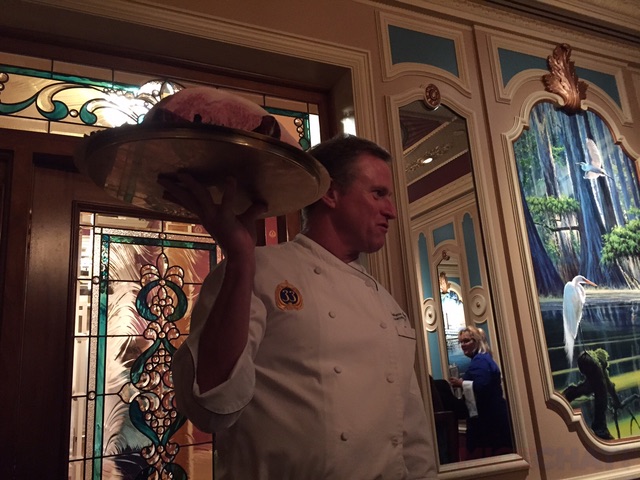
The 21 Royal Street dinner will actually be overseen by such a chef. Andrew Sutton (also the head chef of Napa Rose and Carthay Circle) will not only create those seven courses, he’ll do so while taking into account your preferences. The official website mentions customization and theme, which makes me think that if you wanted a seafood extravaganza, dominated by scallops and lobster (for example), Chef Sutton would see to it that your meal is dominated by the desired ingredients (in fact, I’m reasonably certain this sort of thing is highly gratifying for a top chef to be asked to do). Like the caliber and quality of ingredients, this is going to make the experience very different from a “normal” Disney table service dinner, and part of the reason that “adding a zero” may make sense.
Let’s assume, for the moment, that the value added by personalized attention from a top-quality chef, truly world-class ingredients, and theme/customization really did mean that “adding a zero” wasn’t outrageous. That an $80 meal at Blue Bayou and an $800 meal at 21 Royal Street could, in some sense of the word, be looked at as experiences priced proportionally (meaning: appropriately, given what you get for each). And it further assumes that there is a market of people with this much disposable income.
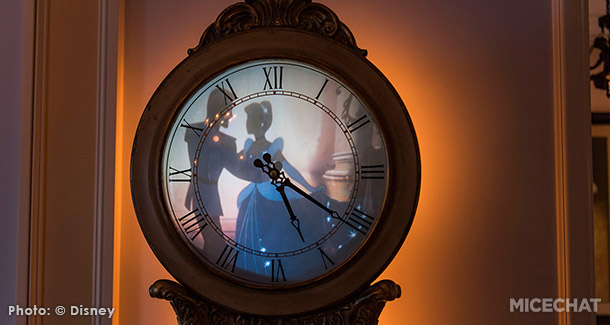
Even if we grant all of that, we aren’t all the way to the actual cost of $1,250 per person (assuming you max out the dining room, and it would be in your interest to do so, since the $15k is the actual cost no matter how many come). Is there a path to the remaining $450 we need to bridge?
Actually, there may be. The public-facing offer of $15k (or $1,250/person) includes park admission ($100), valet parking (perhaps $50), and gratuity. The tip alone is hugely significant. If you run the calculations for what $15k would look like before a 20% gratuity, you come up with $12,500, which is only $1,041 per person. We are within spitting distance of “accounting” for all of the value added on the price already.

This is around the time it’s worth remembering that the experience is not restricted to dinner. You get to explore the Dream Suite (would a Disney fan pay $200 for a few hours in there, taking photos? I think so). You get free cocktails and drinks (surely that’s $100/person right there). You get to watch Fantasmic from the balcony without being crowded (probably another $50/person). And in early versions, patrons were also allowed to visit the Lilly Belle parlor car on the railroad (usually reserved for expensive tours).
Let’s add that up backwards and END with the actual dinner cost:
- Lilly Bell (assuming it’s included for everyone): $100
- Fantasmic Balcony: $50
- Cocktails: $100
- Explore Dream Suite: $200
- Gratuity: $200
- Valet Parking: $50
- Park Admission: $100
That’s $800 *before* we even think about the food. So what we’re really talking about is paying $250 for a seven course meal prepared by a world-class chef, using five-star dining type of ingredients, customizing and providing a theme as you direct. The overall experience is sure to be many hours (no less than three, and probably closer to six).
The dinner part is actually not that “expensive”, put into those terms.
And yet: the bottom line “expense” is still $1,250 per person (assuming you have that many friends “of means” who can afford to go with you). The above kinds of arguments can (rightly) be called rationalizations, or maybe even justifications, for people who love the Disney product no matter what. I probably fall into that category myself.
As we noted earlier, even the baseline Disney park experience is expensive and “prices out” many families. By aiming at the very high end of the distribution Long Tail, Disney is exposing itself as chasing the ultra-rich. A simple ratio-proportion calculation tells you that if the $80 meal is a “fit” for the family making $100,000, then the $800 meal is a fit for the family making $1,000,000 annually. And the proportional expenditure for $1,250 means the family would have to be making $1.5 million every year.
That’s what we’re talking about: Disney is now, in a way, targeting annual household incomes of $1.5 million. Such a family would treat the 21 Royal Street dinner the way a family making $100k/year treats the Blue Bayou (in other words, “expensive, but worth it as a treat since today is a special day.”)
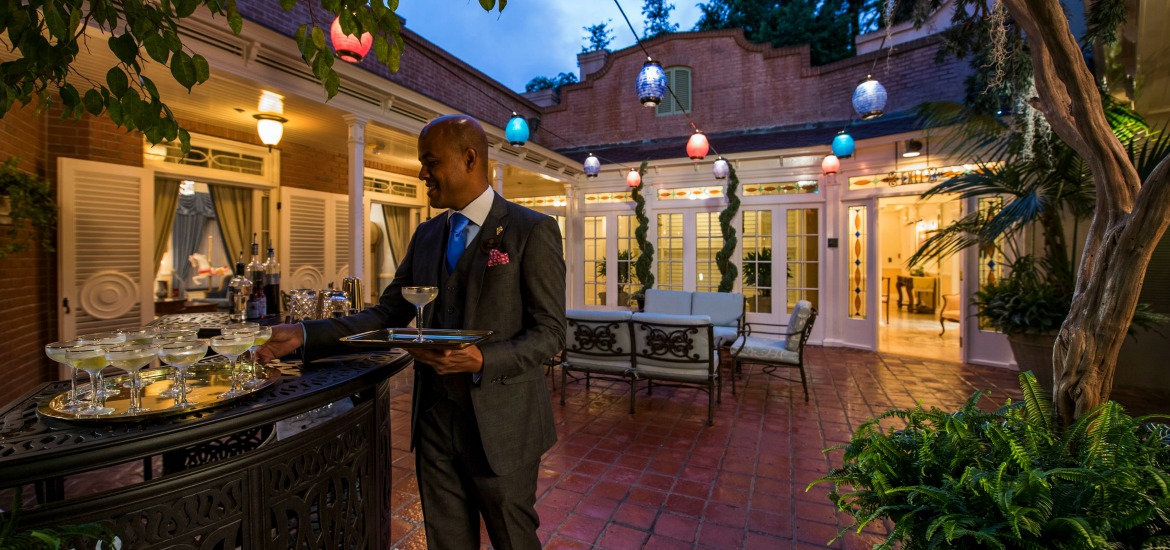
If we wanted to pause and look at socio-economic factors for a moment, Disney’s marketing of the 21 Royal Street experience is telling. Among the photos on the official website is one showing a male cast member wearing a fancy, and conservative, suit.
By contrast, the women’s costume appears to have a different tonality altogether.
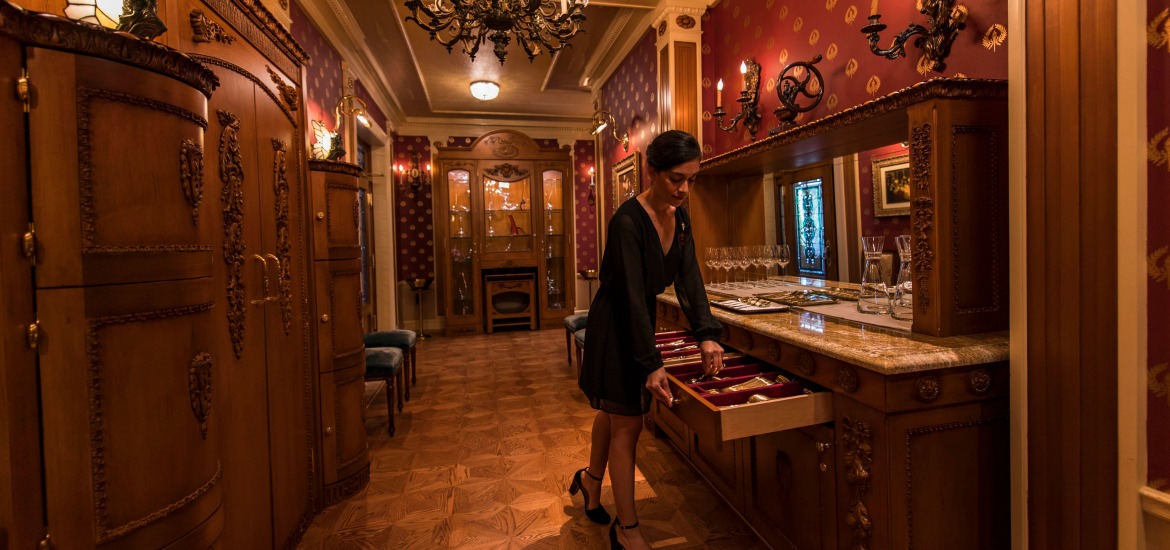
The female costume is way more sexualized than the male costume. Does this bespeak a certain attitude of the targeted ultra-rich clientele? Men are not to be sexualized, but women are? To me, it says “negligee” rather than professional dress (except for the long sleeves). This may actually be the most sexualized costume in the Disney theme park universe.
The male server is black and professional; the female server is white (olive-skinned?) and sexualized. The intersection of race and sex here may in fact be mere coincidence, but then again marketing is always carefully crafted. The message may be perceived by some audiences as both sexist and racist. I wish the Disney marketers recognized the signals they are sending to the broader population, even if the reality is that the ultra-rich clientele probably does skew white and male.
$1.5 million annual income is pretty far removed from the mainstream, populist vision cultivated by Walt Disney. It’s more the realm of the person who owns a boat, maybe even a yacht. The business question then becomes: what does the Venn diagram look like of such ultra-rich patrons overlapping with those being interested in Disney parks and the history of Disney parks? For them to offer this deal suggests they think there is enough demand in that overlap.
I’m less certain of that, and ultimately I think we won’t see this opportunity last for long. The Club 33 members may have that kind of disposable income (though apparently they can reserve this private dining at a significant discount), but I think the general public won’t. After we see a flurry of die-hard Disney fans experience it just to take the inevitable photos, demand is likely to shrivel.
In fact, I may just “call it.” This, right here, is the moment when Disney finally finds out “what the market will bear.” I think this is the peak, the cap, and the last time we see such extraordinary pricing. At least I hope so.
Your comments and impressions are welcome!