


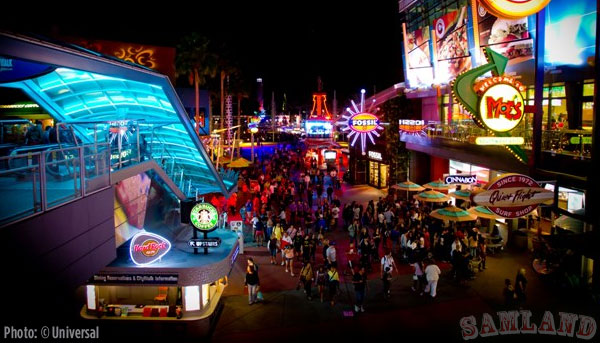
Recently, I took a trip back in time to the genesis of CityWalk at Universal Studios Hollywood. This week I will turn my attention to its big brother in Florida. In 1991, just after the opening of Universal Studios Florida, Universal began to develop a master plan for the Orlando property. The plan called for movie theaters, hotels, and nighttime entertainment similar to what was proposed for Universal Studios Hollywood.

Just like Hollywood, the shopping and entertainment center would be placed between the parking structures and the theme park entrance. Universal’s Ron Benison said of the plans, “I think we know where we want to be in the next five to 10 years. We would like to see attractions in Europe and Japan, and we would like to see the buildup of our sites in Orlando and Hollywood.” He added, “I believe we have a formula, invented at CityWalk and improved here, that could work both domestically and internationally.”
Consultant Harrison “Buzz” Price said that the combination of the theme parks and the entertainment center “works like a slot machine” drawing people almost automatically. Just prior to opening in late 1998, the name was changed to CityWalk to match Hollywood. The three-level Orlando entertainment and shopping center stretched along a canal that connected the center to the hotels. At the center was a plaza with an outdoor stage. On the other side of the canal were Universal Studios Florida and Islands of Adventure. According to Benison, the architecture was “Floridan themed” with “a lot of water and lush landscaping and a lot of neon” plus Southern plant life, cuisine and music.
Unlike Walt Disney World’s Pleasure Island, which opened in 1989, and the very popular Church Street Station in Downtown Orlando, CityWalk was not a gated attraction. Universal wanted to take advantage of its location near the Orange County convention center and its hotels. By the mid-1990s, the convention center was attracting approximately 15,000 meetings a year. Universal’s Tom Williams said, “You’ve heard of the three most important things in real estate: location, location, location. This is that to the 10th power.”
When the project was first announced, one of the biggest attractions was Shaq’s Place, “a giant nightclub for a giant.” The 31,000 square foot multilevel club would have a half court dance floor, a high tech game room, and a private VIP lounge. Basketball star and owner Shaquille O’Neal said, “The E-Zone is going to be a rock ‘n’ roll place. It’s going to be a rap place. It’s going to be a fun place.”
However, by October 1997 it was not to be. Plans for the Shaquille O’Neal restaurant collapsed and the space was handed over to musician Jimmy Buffett. The Orlando Margaritaville Cafe was the largest of the three-restaurant chain. The other locations were in Key West and New Orleans. Just outside was a replica of a Boeing 314 seaplane. Inside was a 20-foot wood sculpture of a whale and dolphin. A replica of the underside of the Florida Key’s seven-mile bridge spanned one side of the main dining room. In tribute to the song 12-Volt Man, the back of the bar was covered in car batteries hooked up to blenders that served boat drinks. Every so often a 20-foot volcano would erupt and guests were encouraged to pin business cards and dollar bills on a 20-foot sail.

There were three other attractions that were announced initially but did not open. The E! Entertainment Television Production Center would have allowed visitors to watch filming for the cable television network. The Sega GameWorks mega-arcade would have covered 50,000 square feet on three levels. Finally, BB King’s Blues Club lost out to CityJazz.
When CityWalk in Orlando did debut in the fall of 1998, it featured an eclectic mix of shops plus thirteen restaurants and clubs. What the public did not know was there was room for four more. Universal would not be caught off guard if the place immediately took off. To guarantee that the center would open with the correct mix of restaurants, Universal offered to partner in exchange for a share of the sales and profits. Irc Floral, vice president and general manager for CityWalk candidly said, “It was a way to get them to come here.” Jimmy Buffett’s Margaritaville Cafe was one of the restaurants. Others included the NASCAR Cafe themed to the popular auto racing series, the Hard Rock Cafe, and the Motown Cafe.
Bringing the Hard Rock Cafe to Universal was quite a coup. The $5 million guitar shaped restaurant was the largest facility in the chain and the first to open in Florida. Outside was one of the few large pieces of the Berlin Wall visitors could see in the United States. Inside the restaurant was a museum dedicated to rock and roll memorabilia called The Attic. The John Lennon Room was all in white with actual artifacts from the singer. The Roots of Rock room used bricks from the famous Cavern Club where the Beatles performed in Liverpool. One of special perks for Hard Rock guests was an exclusive second entrance into the theme park. On July 15, 1996, the Motown Cafe announced that would also open at Universal instead of Walt Disney World.
Michael Eisner said, “When we [Disney] were offered the chance to bring the Hard Rock Cafe onto our property, for example, we passed.” He told his Imagineers, “We can do our own rock ’n’ roll themed restaurant.” He lived to regret that decision. “It was at the parks, in particular, that we felt we should do everything ourselves,” he said. “We were the experts, and no one could do it as well as we could. I was as guilty of this ‘Let’s do it all ourselves’ attitude as anyone else.” When the new restaurant turned out to be a smash hit, Eisner conceded, “Making a mistake once is painful, but there has to be room for failure, or no one will ever take chances.”
Another success at CityWalk was the two-story, 400-seat Motown Cafe. Out front was a 15-story radio tower. Inside was a restaurant filled with memorabilia including a thirty-foot tall replica of the Jackson Five’s early hit record ABC and featured their own in-house band called the Motown Cafe Moments.
Universal convinced celebrity chef Emeril Lagasse to open a recreation of his original restaurant in the warehouse district in New Orleans. On display were 12,000 bottles of vintage wine stretching 50 feet across the second floor. There was also an eight-person cigar room. Pat O’Brien’s Irish Bar was another New Orleans import. The Universal design team took thousands of photos of the original in New Orleans in order to recreate the exterior and the patio in the back. Like the original, the patio had the signature fire and water fountain installed. Inside visitors would find two bars, including one with dueling pianos, and Pat O’Brien’s famous Hurricane drink.
Next-door was Bob Marley – A Tribute to Freedom. The nightclub was patterned after the reggae star’s home in Kingston, Jamaica, which was converted into a museum after the reggae star died in 1981. Jazz fans could visit CityJazz, which was decorated in a mix of natural wood with purple and green decor. A montage of jazz stars filled one wall while glass cases showcased jazz memorabilia.
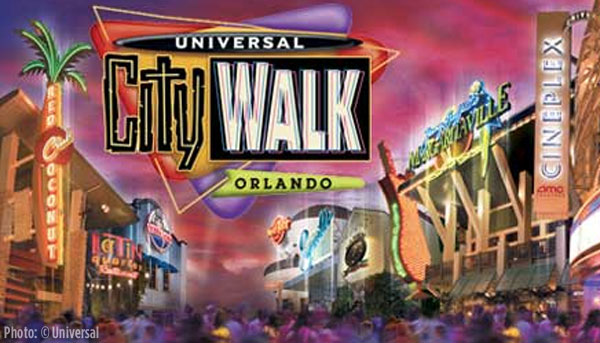
Nearby was the Latin Quarter. The $10 million, 20,000 square foot restaurant featured “Nuevo Latino” cuisine. The architecture reflected the passing of time as guests go from Spanish colonial architecture to Mayan, Aztec and then Incan. Inside was a replica of the Andes Mountains complete with a waterfall and a jungle stream surrounding the dance floor.
The Groove was another dance club that looked like a turn-of-the century theater that was converted into a nightclub. The decor suggested a two-story wall of video monitors and spotlights had replaced that movie screen. Throughout the club were small lounges and intimate spaces.
On the other side of the lake was NBA City, a joint venture between the National Basketball Association and the Hard Rock Cafe. The facility was the first of a proposed chain of ten restaurants.
Even the retail stores got special attention. For example, Cigarz’s interior was a replica of a 1920 cigar-drying barn with lumber from a 1860s New England barn. For the locals there would be a 16-screen Cineplex Odeon movie theater.
CityWalk was only one piece of the resort puzzle. The 750-room Loews Portofino Bay Hotel opened in September 1999. Steven Spielberg suggested a hotel based on the Mediterranean fishing village of Portofino, Italy would be a good theme. The area was known for its luxury hotels along the shoreline. Wandering the grounds, guests would come upon a bocce ball court and a Jacuzzi with waterfalls. The hotel featured a health spa and 65,000-square feet of meeting space. Part of the show was the themed dining experience called Mama Della’s Ristorante where Mama was the host.
The Hard Rock Hotel opened in February of 2001. The 650-room hotel was built on a two-acre site very close to the Studio park entrance and designed to target younger families. The Eagle’s Hotel California album cover inspired the architecture and an estimated $800,000 worth of rock and roll memorabilia could be found throughout the hotel. Music was everywhere with 980 speakers in the public spaces of the hotel and another twelve pumping sound into the swimming pool. A branch of The Palm, a show business favorite, became the only steakhouse on Universal property. Guests could access the theme park front gates and CityWalk via water taxi or a meandering walking path.
CityWalk and the Portofino Bay struggled in 2000. The Orlando Business Journal reported that the center was “off to a slow start with sales well below expectations.” Geoffrey Weller of the Latin Quarter nightclub stated, “Are we where we thought we would be? Probably not. We had some pretty high expectations.” Just like Hollywood, the secret of success would be to target the locals. Starting in January 2000, Universal eliminated the parking fee after 6:00 p.m. As a result, traffic doubled. The impact was felt at both Disney’s Pleasure Island and Church Street Station. CityWalk was starting to become the locals’ hangout. Chris Havlicek of NBA City said, “When they dropped the parking fees, they said they wanted to get the locals to come.” They were right.
Are you nostalgic for early Universal Orlando CityWalk?
If you enjoyed today’s article, you’ll probably want to pre-order my upcoming book on Universal Studios history:
You may also enjoy my two recent books: