|
Part One of this story is at this
link.
Part Two of this story is at this
link.
Part Three of this story is at this
link.
On March 1st, 1959 the engine was loaded onto a flatbed truck for
her trip from the Disney Studios to the Disneyland roundhouse for final painting and
testing. The color scheme chosen was a bright red on the boiler, cab and wheels.
Red has always been one of the most expensive paints to produce. In fact, early
firemen often chose to paint their apparatus in shades of red to show their
pride in their fire fighting machines--a tradition carried on to this very day.
Elaborate pinstriping adorned the cylinders and headlight, and bright brass
rounded out the trim.

The engine simmers in front of the old roundhouse shortly
after completion.
In an unusual change from the practice on the three previous Disneyland
engines, no stars were painted on the drive wheel hubs, and the drive wheel
tires were painted in white. Continuing the tradition of naming his engines
after Santa Fe executives, Walt chose to name the engine Ernest S. Marsh,
a nod to the assistance the Santa Fe president had given in returning Walt's
"lost locomotive" to him. The fact that the Santa Fe had just signed the first
five-year contract extension to sponsor the Disneyland trains probably didn't
hurt either.
After a couple months of finishing and testing, the engine was ready to enter
service. Unlike with the Fred Gurley, the Marsh was not formally
dedicated. On July 25, 1959, the little engine entered service, to little
fanfare.

Here's the engine as she appeared on the cover of
the 1982 souvenir
guide (Presented by Polaroid).
With only three sets of cars to pull, the engine was never "assigned" a
train, as had been done with the first three engines. The Ernest S. Marsh
could be found pulling any of the three sets of cars on any given day. Three
train sets meant that only three trains could be run simultaneously, even with a
fourth engine. That changed in the mid-1960s, however, when two new sets of cars
were built--the Holiday Blue and Holiday Green cars, with their blue and green
striped awnings, respectively. Now, four trains could be operated simultaneously
during busy times.

The Fall 1968 cover of the Disney News featured the engine
in great light--with the whistle blowing quite loudly.
In May 1967, the engine reached a milestone at Disneyland. Jerry Best took
some photographs and wrote to the owners of the Pine Creek Railroad, the tourist
line where the engine spent time in the early 1950s, to update them on the
progress of their former first engine. Best wrote on May 2, 1967, "Thought you
might like these photos of former Pine Creek #1, which has just completed 50,000
miles of service on the Disneyland railroad. Of course, not much of the original
engine is left…The tender was discarded and Ward Kimball and I got it, and some
day it will be a duplicate of a Disneyland horse car. The engine today even has
a ‘feet per second' speedometer to control the speed through the dioramas. Sorry
the engine doesn't smoke in the shot of the train emerging from the tunnel;
smoke is forbidden due to smog laws, and special chemicals are used in the
distillate to eliminate soot from the fires."

This mid-'60s publicity view shows the white wall tires and
starless drivers the engine wore originally.
In operation, crews have noted that the Marsh can be one of the
roughest-riding engines on the line. It's been theorized that the spring
suspension was designed to support the weight of a saddle tank. The added weight
would compress the springs a bit. Removing the tank allowed the springs to
remain rigid, resulting in a rougher ride. She consumes 140 gallons of water and
12 to 14 gallons of fuel every hour when operating.

ABOVE: A look into the backhead of the
Ernest S. Marsh. A quick
tour: The two curving white pipes lead to the water sight glasses that tell the
crew how much water is in the boiler; The two green valves on the right do the
same thing, but by spitting out steam or water instead. The bright brass gauge
at top center is the steam pressure gauge, and the smaller gauge to the right
shows the air pressure in the brake system. The horizontal bar below the brake
gauge is the throttle. Photo courtesy Dennis Flores.

ABOVE: A rare view inside the
Ernest S. Marsh's front end. The
"holes" are actually pipes that run to the engine's firebox, through the water
carried in the boiler. The large curved pipe carries steam from the steam dome
to the cylinders. Photo courtesy Preston Nirattisai. BELOW: Walt Disney in the
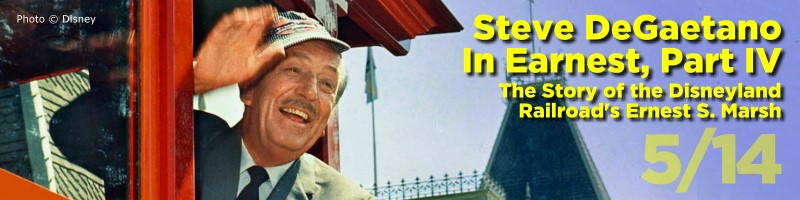
Ernest S. Marsh's cab in an undated publicity shot.

While Walt certainly enjoyed the engine, even going so far as to having a
publicity shot of him made while in the cab, the Ernest S. Marsh held a
dubious distinction: Until the Ward Kimball's arrival in 2005, she
remained the only Disneyland engine to never have appeared on an attraction
poster--a record spanning some 46 years (and counting). A few postcards were produced over the years, and the engine appeared on a
very nice collectible plate by the Bradford Mint, but in 2002, the Marsh
was treated to an unusual plethora of train-related merchandise that featured
her image.
BELOW: This early postcard shows the Marsh to good
advantage.

ABOVE: The back panel of a denim jacket released in summer 2002 features
this
great artwork of the Ernest S. Marsh, and in unusual fashion,
mentions the
engine by name. (Most Disneyland Railroad collectibles do not
make
such distinctions between the trains).
The Park was in the midst of celebrating Walt Disney's 100th
birthday, and featuring trains seemed to be a natural. A coffee mug showing the
engine steaming into Main Street Station was made. Denim shirts and jackets were
available with the same image. A pin set consisting of the Marsh
locomotive, tender and several cars was made, each in a limited edition of
1,959, signifying the engine's debut year on the Disneyland Railroad.
This year marks the Ernest S. Marsh's 50th year as a
Disneyland Railroad locomotive, and her 89th birthday overall. She
has continued to delight guests since the Park's formative years, and with the
constant and loving maintenance she receives from her dedicated crew, there is
no reason why she couldn't see another 50 years as Disneyland Railroad engine
No. 4.

The fireman of the Ernest S. Marsh waves kindly to guests
just arriving
at Walt Disney's Magic Kingdom. Photo courtesy Matt Walker
She may have started out as an olive drab ugly duckling in 1925, competing
with the very first diesel, but today when her ruby-red paint is waxed to a high
luster, she's the queen of the fleet.
|