| Gurley Story
(continued)
The next night, a train set was attached to the locomotive--perhaps not
coincidentally, the Excursion cars--the train cars the engine was meant to pull,
and the engine was tested with a load. Operating Engineers Craig Ludwick and
Dale Tetley operated the engine to make sure it met their expectations. The cab
is quite small, so Boschan positioned himself on the front platform of the first
car, enduring biting cold as the train rolled around the line. The little train
made ten complete circuits of the Park.
On the third night a second set of cars was attached to the train to the
Excursion cars, in order to simulate the weight of a full train. Five laps
around the Park were completed before another small problem needed attending.
With daylight approaching, it was determined that the testing should continue
after the weekend.
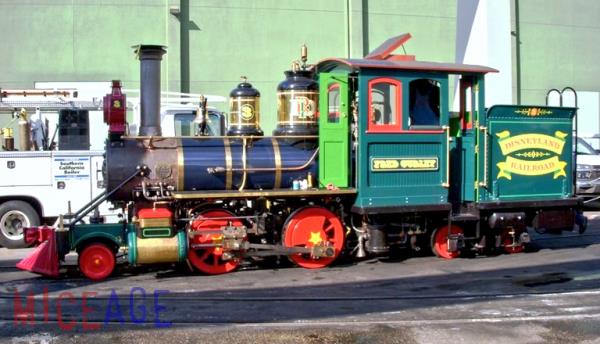
The Gurley in the shadow of the Monorail
beams in February 2008.
Testing continued on Tuesday and Wednesday mornings, before the Park opened.
On Thursday, January 17, the engine had her accelerometer test. Yep, the state
of California requires tests to be made with an accelerometer--a device that
measures the "g," or gravity forces generated by an attraction (the same tests
are performed on roller coasters to make sure their g forces are within safe
limits, meaning that they won't cause the average guest to pass out. Which begs
the question: Does the state really believe that a 114-year-old steam locomotive
unable to run faster than 35 miles an hour is capable of creating
blackout-inducing g forces?).
Over the course of the next few weeks, additional bugs were worked out. The
engine was built to perform at the higher steam pressure of 150 pounds per
square inch, 25 pounds higher than the C.K. Holliday and the Ernest S.
Marsh run at with their older boilers. This caused the Penberthy-made
injectors--which force water into the pressurized boiler--to not operate properly.
New, higher-pressure injectors solved the problem. The engine passed her barrage
of tests, and on Tuesday, February 19, 2008, the engine was officially accepted
back into the Disneyland Railroad family, and the mechanical portion of the
project deemed complete.
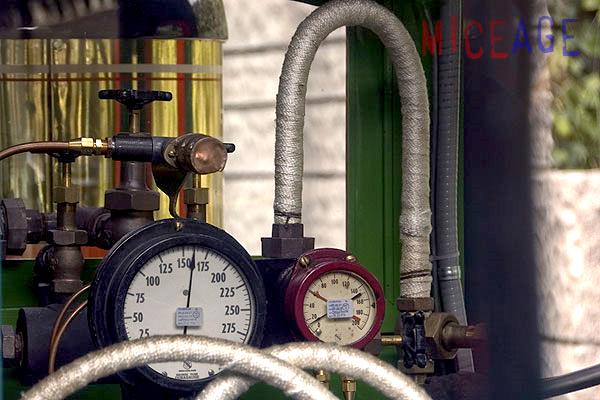
Outside near the whistle, steam feathers from the safety valves as the Main
Pressure Gauge shows the steam pressure hovering around 160 pounds.
Photo courtesy Matt Walker
Cosmetic work continued on the engine. Notably, the pilot and headlight,
which had been painted in a darker burgundy color, were removed and repainted to
match the brighter red of the drivers. The roundhouse crew relied on Michael
Broggie's book, Walt Disney's Railroad Story, to determine the proper
colors. There are two color photos of the engine in the book. One, clearly taken
on the engine's test runs in March 1958, showed the brighter red. A shot
apparently mis-dated for the same month, showed the darker red. Art Director Kim
Irvine had been unable to attend the meetings where the colors would be
finalized (she was busy with the Dream Suite at the time), so the
roundhouse crew took it upon themselves to make the executive decision, and have
the headlight and pilot repainted to approximate as closely as possible the
engine's earliest colors.
At 10am on Wednesday, March 5, exactly 50 years to the month that the
Fred Gurley made her first powered circuits of Disneyland hauling
passengers, engine crew Royce and Damien mounted the cab and whistled as they
steamed the newly-restored engine out into the Park. As when the Ward Kimball
made her official Park debut in June 2005, there was no fanfare for the event;
few visitors that day knew or understood the significance.
According to
engineers and roundhouse personnel who have run the engine, the little
locomotive may be the best-running engine on the line now. She was always a
favorite of crews because of her reliability and ease of operation. One engineer
reported that, "Number 3 as she stands right now, is probably the best engine in
the Roundhouse! Quite a few OE's (operating engineers) and Engineers are loving
how she's running!" Fine praise indeed for Boschan and his crew. "A lot of good
talent went into this project, a real team effort," Boschan replied.
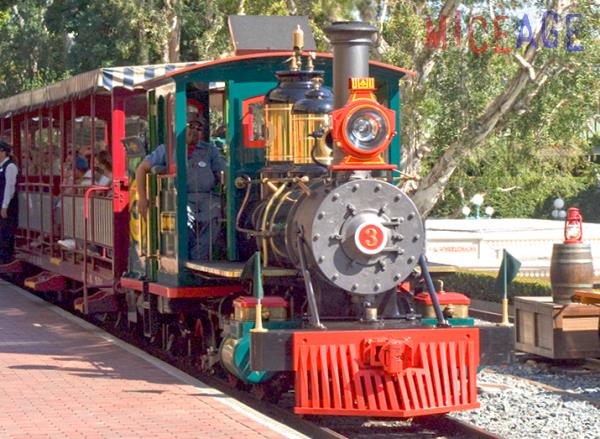
The afternoon sun gleams off the engine's pilot on March 5, 2008,
her first day back
under steam in over a year, as the engine rolls into Mail
Street Station.
Photo by Maurie Seymour.
The job had begun 14 long months ago with the complete teardown of the
venerable little locomotive by Mission Tool. During the intervening months, many
people were involved, both directly and indirectly, in an almost Herculean
effort to restore this living bit of American industrial history. Paul Boschan
is proud of his work, and takes great satisfaction that he's had some small part
to play in Walt Disney's grand endeavor. Now, with the job complete, guests can
once again marvel at and ride behind the amazing little Fred Gurley.
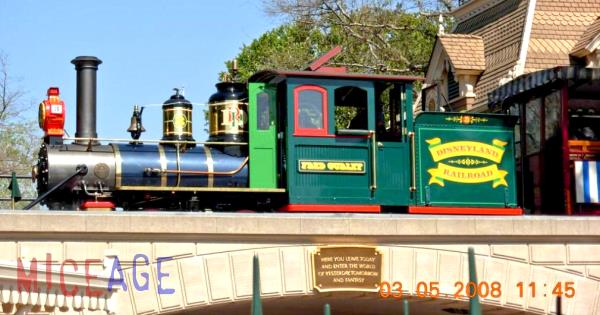
This photo is one of the few taken of the engine as she re-entered
service after 14
months in "rehab." Thanks to "Mowsefan" for speeding over 80
mph on his
lunch break to catch this view of the engine on that day.
She's the oldest steam locomotive in operation in any Disney theme park, and
is one of the oldest operating steam engines in the entire country. Almost
daily--in an ironic twist of fate--she sounds her whistle past the facades of Old
New Orleans, as once she did over 100 years ago near the real Crescent City.
Because of the efforts of a dedicated few, notably Mission Tool, Paul Boschan
and his crew, and some devoted Disneyland Railroad cast members--who are really
not so much cast, but more like keepers of the flame--the Fred Gurley
steam locomotive continues to run. And with dedication like that, she'll no
doubt see another 100 years of operation at America's favorite Theme Park.
|