| The Columbia Story
(continued)
The Helm
There's got to be a way to steer a ship, and the helm is the business end of
steering. Unfortunately, there are many misconceptions about the helm and how
it works.
In the late 1700's, the prime sailing time for Columbia
and Lady Washington, the famous "ship's wheel," which is a large
wooden wheel with many spokes, was not yet a popular feature on ships. In fact,
most boats and ships of that time were steered by the tiller--a simple, long
wooden pole that sticks out from the top of the rudder. To steer the boat or
ship was a simple matter of pushing the tiller--in effect pushing the rudder,
one way or another to turn the vessel.

Here is the tiller of the Lady Washington. Unexpectedly, the ship does
not use a wheel. Photo courtesy Preston Nirattisai.
While the tiller does provide some mechanical advantage through the principle
of leverage, it can be quite a tiring task to keep the ship on course,
especially in heavy seas. Steering a sailing ship (weighing up to 200-300 tons)
is no simple task for a novice, so a watch at the helm is called "a
trick". As ships grew larger in the very late 1700s and early 1800s, their rudders grew
accordingly. And as their rudder grew, their tiller had to grow, too.
Eventually the tiller became so big that it couldn't be handled by sailors, so
shipbuilders rigged another device, or "purchase" on the tiller. This
became the "wheel" that is so famous today. The ship's wheel was
simply rigged to a barrel at the center of the wheel. Wrapped around this barrel
is a length of rope that goes down below deck, and through a system of pulleys,
to the tiller itself. The wheel was simply a device to give sailors additional
mechanical advantage to move very big tillers. But in the time of Columbia and Lady Washington, most ships would
have been steered by a tiller. Disney's Columbia today has a wheel--a
much romanticize vision of sailing ships.
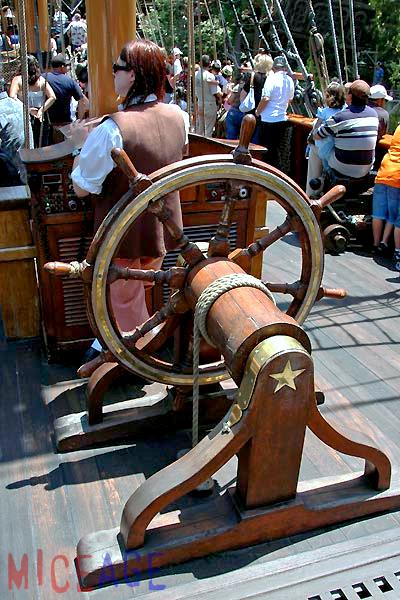
This is the Columbia's helm. Of course, while the wheel moves,
it is not connected to the ship's rudder. But the detail showing the barrel
with the rope looped around it is quite authentic. Photo
courtesy Matt Walker.
In the first Pirates of the Caribbean, the Lady Washington,
playing the HMS Interceptor, is seen having a wheel. That wheel was
specially rigged for the movie (and for Johnny Depp to play with). The wheel
system in the movie was wildly unpopular with the ship's crew because it was a
bothersome piece of equipment, while the tiller is a straightforward stick to
steer the boat with. History
The Columbia discovered the "great river" that had
been rumored to exist in the Northwest. The confirmation eventually led to the
Lewis and Clark expedition that opened the west. The Columbia's name
remained tied to exploration, and in 1981, America's first operational space
shuttle adopted her name.
Through 1787, the original Columbia and Lady Washington sailed
together in an unprecedented American mission to explore and trade with the
Pacific Northwest. Today, their replica sisters still share some of the same
history. Not only did Ray Wallace design both, but they spend part of their
time playing pirates--Columbia in Fastasmic! and
Lady Washington in Pirates of the Caribbean as the HMS Interceptor.
Sailors of both vessels also hate being called pirates, instead preferring to
be known as honest, merchant sailors.
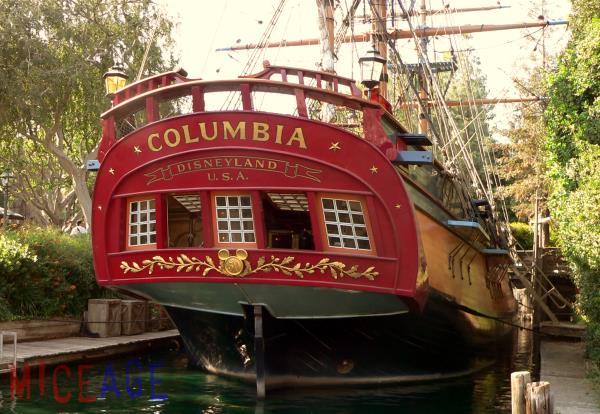
More bling-bling was temporarily added
to the Columbia during Disneyland's 50th anniversary.
Both vessels aim to educate the public about America's mostly-forgotten rich
maritime history. I hope this doesn't come across at nick-picking Disney and
the Columbia, but instead I hope that I've educated you on the details
and intricacies of sailing ships, and I hope you now have a new appreciation
for them and their history. And if the Columbia at Disneyland fascinates
you, inspires you, and motivates you to explore its history, the history of
trading, and how it became the first American vessel to circumnavigate the
globe, then I think Disney and Columbia have done their jobs.
This
article could not have been written without the assistance and knowledge of
Jeff Maillian, of Maillian Associates Design
http://maillian.net/,
a full-service yacht and passenger vessel design office. Jeff, having
worked to restore the vessel in 2004, knows her completely, inside and out.
The best book available on the story
of the real Columbia is "Hail Columbia," by John Scofield, Oregon
Historical Society Press, 1993.
The Columbia's recreated
sister-ship, Lady Washington, cruises up and down the west coast, and
offers several ways to experience the ship, from touring her while docked, to
sailing out to sea to experience a full re-created sea battle! If you, like
Preston, have been inspired by Disneyland's Columbia and have a yearning
to experience something more, the Lady Washington may be a good choice.
http://www.ladywashington.org/
|